The complete source code for this project is available on GitHub: GitHub - KAG-Ming/simple-proxy-go
Last time we implemented a simple SOCKS5 server. Today we’re going to implement an HTTP/HTTPS proxy server. Similar to the previous project, this is for educational and practice purposes only and is not production-grade.In fact, this implementation is much simpler than SOCKS5; I probably should have started with this one.
1 HTTP/HTTPS Proxy Introduction
Technically, an HTTP proxy server is highly similar to a standard HTTP web server. Both listen for incoming TCP connections and parse HTTP request messages. However, instead of locating a static file on the local file system to serve the client, a proxy server parses the destination address from the request, establishes a new TCP connection to that target server, and forwards the data.
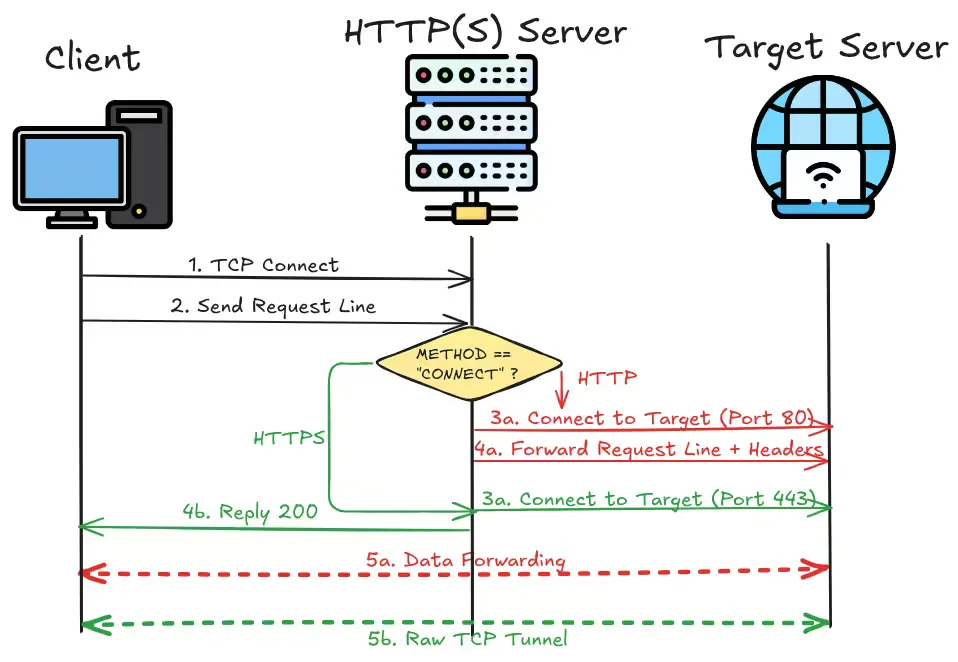
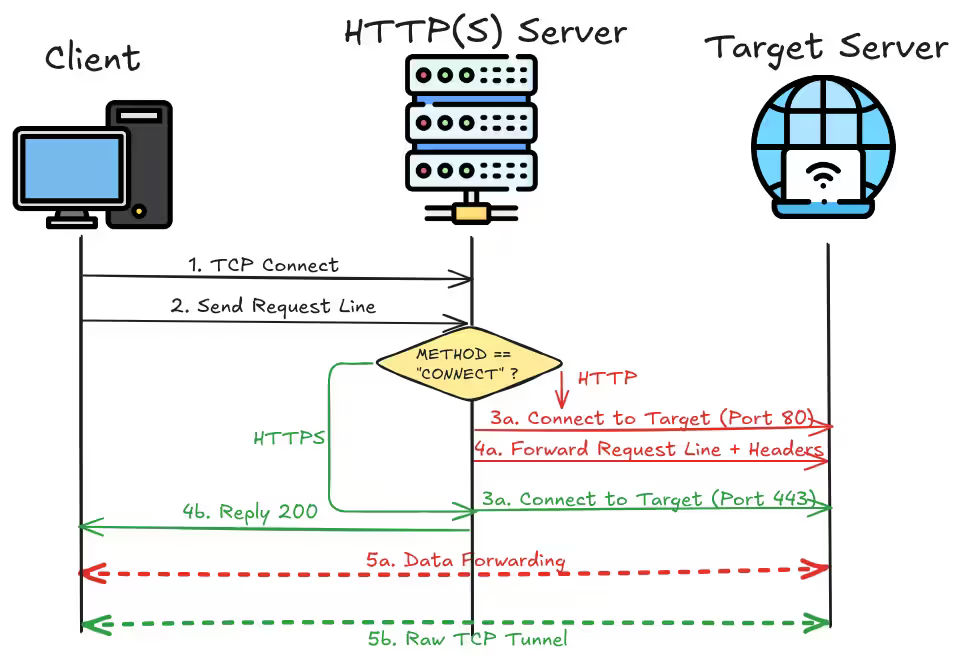
According to these standards, when a client configures an HTTP/HTTPS proxy, its connection life cycle and request format split into two distinct workflows depending on the scheme:
1.1 HTTP Proxy Workflow
For unencrypted HTTP requests, the client sends a request using the absolute-form uri specification. The Request-Line includes the full scheme and host:
// method(POST/GET/...) + absolute uri + http version
GET http://google.com/ HTTP/1.1
The proxy server parses the target host, establishes a TCP connection to it, forwards this entire request (including all subsequent headers), and then streams the response back to the client.
1.2 HTTPS Proxy Workflow
For encrypted HTTPS requests, the client cannot expose the plaintext uri or headers. Instead, it uses the CONNECT method to request a transparent TCP tunnel:
// CONNECT + authority + http version
CONNECT google.com:443 HTTP/1.1
The proxy server parses the authority and opens a TCP connection to the destination. Unlike the HTTP workflow, the proxy does not forward the CONNECT line. Instead, it immediately replies to the client with an HTTP status line: HTTP/1.1 200 Connection Established\r\n\r\n.
Once this response is sent, the proxy drops down to the transport layer, acting as a blind, bidirectional data forwarder for the raw TLS-encrypted traffic between the client and the destination server.
Ref
2 Overall Structure
The architecture follows a straightforward concurrent design. The main routine initializes a TCP listener on a specified port and enters a continuous loop to accept incoming client connections.
For each established connection, the server spawns a new Goroutine to handle the lifecycle independent of others.
func main() {
	addr := "127.0.0.1:8080"
	listener, err := net.Listen("tcp", addr)
	if err != nil {
		log.Fatalf("Listen failed: %v", err)
	}
	defer listener.Close()
	log.Printf("HTTP/HTTPS Server launched, listening at %s...", addr)

	for {
		conn, err := listener.Accept()
		if err != nil {
			log.Printf("Accept connection failed: %v", err)
			continue
		}
		go handleConnection(conn)
	}
}
The core logic inside the connection handler is split into three sequential phases:
- Read and parse the initial HTTP request line from the client to determine the proxying mode and extract the destination address.
- Establish a raw TCP connection to the target remote server.
- Handle protocol-specific handshakes (sending a 200 OK for HTTPS, or forwarding the initial request line for HTTP) and then transition into a bidirectional data copy loop that bridges the client and upstream connections concurrently.
3 Parse the First Line of the Request
We start by creating a bufio.Reader and passing it to the parseRequestLine function.
func handleConnection(conn net.Conn) {
	defer conn.Close()
	reader := bufio.NewReader(conn)

	line, method, destAddr, err := parseRequestLine(reader)
	if err != nil {
		log.Printf("parse the first line error: %v", err)
		return
	}
}
We use the ReadString method to read the first line, and strings.Fields to split it into the method, address, and protocol version. Note that strings.Fields automatically strips any whitespace, including the trailing \r\n.
line, err = reader.ReadString('\n')
if err != nil {
	return "", "", "", fmt.Errorf("read the first line failed: %v", err)
}

fields := strings.Fields(line)
if len(fields) < 2 {
	return "", "", "", fmt.Errorf("malformed request line: %s", line)
}
method = fields[0]
Next, we extract the destination address based on the HTTP method. If the method is CONNECT, we simply return fields[1] because HTTPS requests always provide the address in a host:port format, which can be directly used later.
if method == "CONNECT" {
	// https "google.com:443"
	return line, method, fields[1], nil
}
If it is a standard HTTP request, we use url.Parse to parse the absolute URL. If the parsed host does not specify a port, we manually append the default HTTP port :80.
else {
	// http "http://google.com/"
	u, err := url.Parse(fields[1])
	if err != nil {
		return "", "", "", fmt.Errorf("parse address error: %v", err)
	}
	address = u.Host

	// if no port in u.Host, add :80
	if !strings.Contains(address, ":") {
		address = address + ":80"
	}
	return line, method, address, nil
}
Here is the complete function:
func parseRequestLine(reader *bufio.Reader) (line, method, address string, err error) {
	line, err = reader.ReadString('\n')
	if err != nil {
		return "", "", "", fmt.Errorf("read the first line failed: %v", err)
	}

	fields := strings.Fields(line)
	if len(fields) < 2 {
		return "", "", "", fmt.Errorf("malformed request line: %s", line)
	}
	method = fields[0]
	if method == "CONNECT" {
		// https "google.com:443"
		return line, method, fields[1], nil
	} else {
		// http "http://google.com/"
		u, err := url.Parse(fields[1])
		if err != nil {
			return "", "", "", fmt.Errorf("parse address error: %v", err)
		}
		address = u.Host

		// if no port in u.Host, add :80
		if !strings.Contains(address, ":") {
			address = address + ":80"
		}
		return line, method, address, nil
	}
}
4 Connect to the Destination Server (HTTP Forwarding & HTTPS Tunneling)
The step to establish the TCP connection to the upstream server is identical for both modes, so we keep this logic directly inside handleConnection:
// connect to the destination server
destConn, err := net.Dial("tcp", destAddr)
if err != nil {
	log.Printf("connect to the destination server error: %v", err)
	return
}
defer destConn.Close()
Then, we branch our logic depending on the method.
For HTTPS, the proxy server must intercept the request and reply with an HTTP 200 OK status line to tell the client to begin TLS negotiation.
For HTTP, the proxy must write the parsed initial request line back to the target server, as this line has already been consumed from our buffer.
if method == "CONNECT" {
	// https
	_, err = conn.Write([]byte("HTTP/1.1 200 Connection Established\r\n\r\n"))
	} else {
	// http
	_, err = destConn.Write([]byte(line))
	}
	if err != nil {
		log.Printf("connect to the destination server error: %v", err)
		return
}
5 Bidirectional Data Forwarding
Finally, the proxy server functions as a transparent tunnel to forward data bidirectionally. We define a forward function to handle this:
func forward(reader io.Reader, conn, destConn net.Conn) {
	go func() {
		_, _ = io.Copy(destConn, reader)
		destConn.Close()
	}()
	_, _ = io.Copy(conn, destConn)
}
We execute io.Copy inside a new Goroutine to ensure that both data streams run concurrently.
An essential detail here is that we pass the bufio.Reader instance into the forwarding function instead of the raw conn. When we initialized bufio.NewReader(conn) to read the first line, the reader automatically prefetched and cached subsequent data bytes from the TCP buffer. Passing the raw conn would cause this buffered data to be permanently lost, corrupting the stream. Using the reader ensures that any cached bytes are drained first before io.Copy falls back to reading from the underlying socket.
6 Testing
You can validate the implementation by executing a curl command in your terminal with the proxy flag, or by configuring the proxy settings directly in your web browser.
curl -x 127.0.0.1:8080 https://google.com7 Limitations
- It handles connections strictly on a one-off basis without connection reuse.
- Active connections are forcefully torn down on any error without elegant resource draining.
- Standard HTTP proxies should strip hop-by-hop headers (like
Proxy-Connection,Keep-Alive), which this simple implementation blindly passes through. - …
The complete source code for this project is available on GitHub: GitHub - KAG-Ming/simple-proxy-go