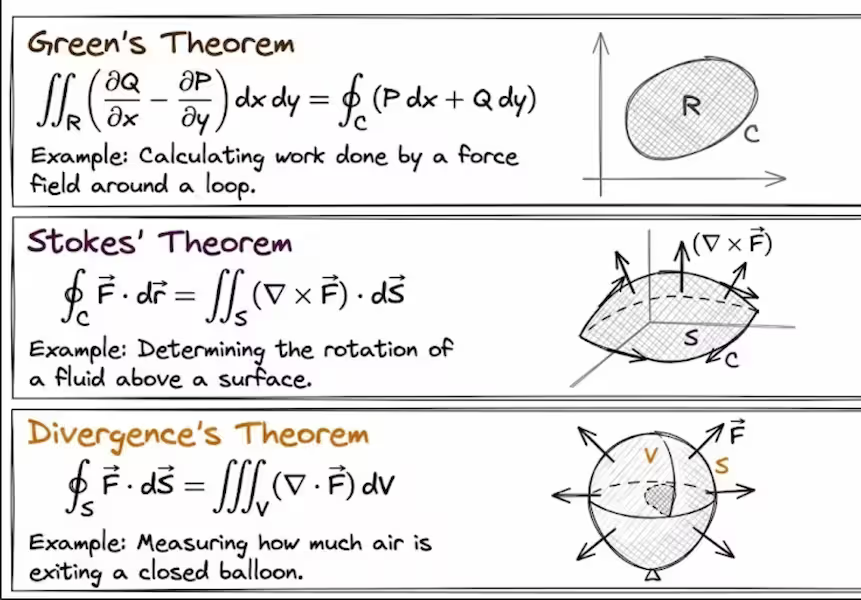
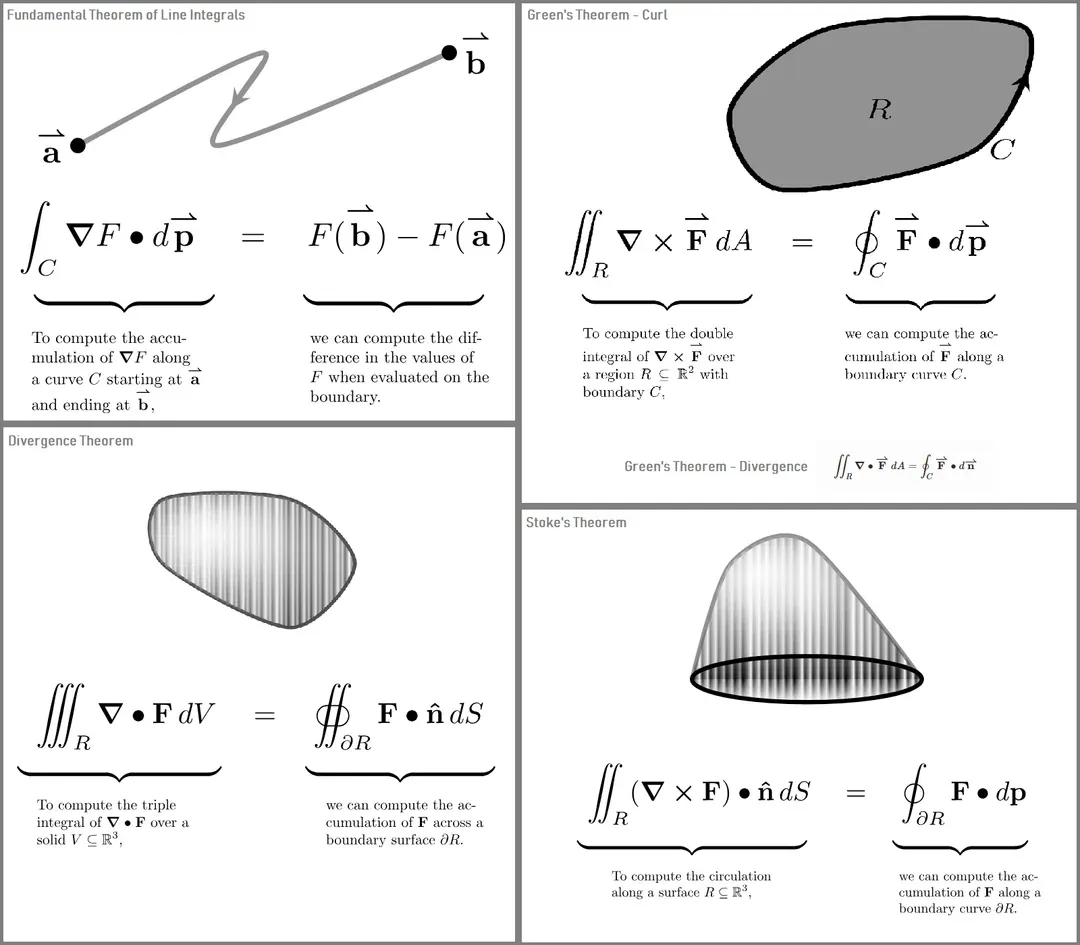
All fundamental theorems of vector calculus are specific dimensional cases of the Generalized Stokes’ Theorem:
∫Ωdω=∫∂Ωω
Where Ω represents the interior region, ∂Ω denotes its boundary, and dω represents the exterior derivative. The core principle is that the integration of a derivative over a domain equals the integration of the original form over its boundary.
1D: Fundamental Theorem of Calculus
Formula:∫abf′(x)dx=f(b)−f(a)
Domain: 1D interval [a,b] with 0D boundary endpoints a and b.
2D: Green’s Theorem
Formula:∬D(∂x∂Q−∂y∂P)dxdy=∮C(Pdx+Qdy)
Domain: 2D planar region D bounded by a 1D closed curve C.
3D Surfaces: Stokes’ Theorem (Curl Theorem)
Formula:
∬S(∇×F)⋅dS=∮∂SF⋅dr
Interpretation: The surface integral of the curl of a vector field F over an open surface S equals the line integral of F along the boundary curve ∂S.
3D Volumes: Gauss’s Theorem (Divergence Theorem)
Formula:
∭V(∇⋅F)dV=∬∂VF⋅dS
Interpretation: The volume integral of the divergence of a vector field F over a solid V equals the net flux of F passing through the closed bounding surface ∂V.
2 Operational Rules of the Del (∇) Operator
The del operator ∇ functions simultaneously as a vector and a differential operator. When applied to products, it follows the product rule (Leibniz rule) rather than the chain rule.
Vector Identity: ∇×(φA)
∇×(φA)=φ(∇×A)+(∇φ)×A
Derivation and Structural Mechanics:
By applying the product rule, ∇ differentiates φ and A sequentially:
When differentiating A, the scalar field φ acts as a constant coefficient and is factored out, yielding φ(∇×A).
When differentiating φ, ∇ operates directly on the scalar to produce the gradient vector ∇φ. The underlying cross product structure (×) with the remaining vector field A must be preserved, yielding (∇φ)×A.
This can be verified by expanding the x-component using partial derivatives: